You notice more hair in the shower. Then more on your pillow. Maybe your hairline looks a little different in photos, or a social post makes you look twice at your scalp.
Hair loss often develops gradually enough that people spend months wondering whether it is really happening before they start looking for answers. And once that search begins, GHK-Cu – often called the copper peptide – is increasingly likely to appear.
So what is it, and can it actually help? GHK-Cu has interesting biology behind it, and research suggests it may support several processes involved in maintaining a healthy follicular environment.
Hair growth is a cycle, not a switch
A hair follicle does not produce hair continuously. Each follicle moves through a repeated biological cycle.
During the anagen phase, the follicle actively grows hair. It then moves through a short transitional phase before entering telogen, a resting period. The old hair is eventually shed and, ideally, the follicle begins a new growth cycle.
When this system is working well, growth and shedding stay roughly balanced. Hair loss begins when that balance changes.
In androgenetic alopecia, for example, susceptible follicles gradually become smaller. Their growth phases shorten, and the thick terminal hairs they once produced can become progressively finer. Other forms of hair loss can be influenced by stress, hormonal changes, inflammation, nutritional status, illness, medications, autoimmune disease or damage to the scalp and follicles.
What is GHK-Cu?
GHK is a naturally occurring peptide made from three amino acids: glycine, histidine and lysine. It has a strong affinity for copper. When GHK binds to a copper ion, it forms the complex generally known as GHK-Cu.
Researchers have studied GHK-Cu for decades because of its relationship with tissue remodeling and repair. The peptide has been investigated for effects involving collagen production, fibroblast activity, blood vessel formation, inflammatory signaling, oxidative stress and skin regeneration.
Those processes are not unique to skin. Many of them also matter inside the environment surrounding a hair follicle. That is where the hair-growth story begins.
Why might GHK-Cu affect a hair follicle?
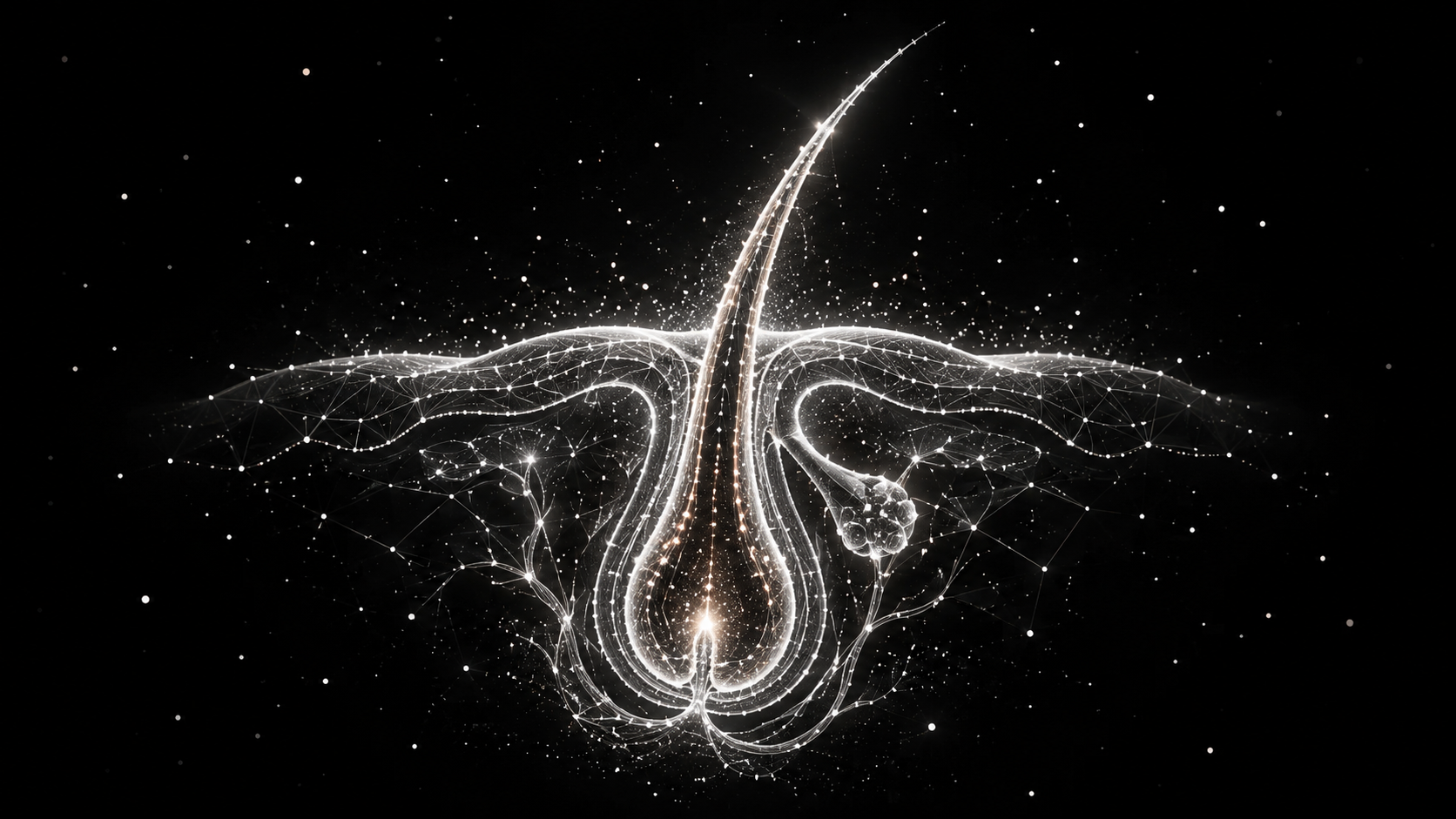
Hair follicles are surprisingly active structures. At the base of each follicle is a group of specialized cells called the dermal papilla. These cells help regulate the growth cycle by communicating with surrounding cells and producing signals that influence whether the follicle remains active.
Copper-binding peptides have been studied for their effects on these cells. A 2007 study from Seoul National University found that a copper tripeptide stimulated the elongation of human hair follicles outside the body and increased the proliferation of dermal papilla cells.
That is interesting because dermal papilla activity is closely linked to follicle size and function. A more active follicular environment may help support the conditions required for healthy hair growth, but this is still only one part of the picture.
Blood supply matters too
An actively growing hair follicle has significant metabolic demands. It needs oxygen, nutrients and biological signals, all delivered through the tissue around it.
GHK-Cu has been studied for its ability to influence angiogenesis, the process through which new blood vessels develop. It also appears to affect vascular endothelial growth factor, or VEGF, one of the signaling proteins involved in building and maintaining blood vessel networks.
That does not mean simply creating more blood vessels will reverse hair loss. The point is broader: the follicle is not an isolated structure. It depends on the quality of the biological environment around it.
The follicle lives inside a tissue environment
The skin surrounding a follicle contains collagen, fibroblasts, blood vessels, immune cells and extracellular matrix. Together, they form what you might think of as the follicle’s microenvironment.
This is relevant because follicle function depends partly on the health of the surrounding tissue. GHK-Cu’s broader role in tissue repair has therefore made researchers interested in whether supporting that microenvironment could also help create better conditions for an active hair follicle.
This broader regenerative activity is one reason GHK-Cu has become widely used in cosmetic skincare. For hair researchers, the same biology raises a related question: could improving the environment around the follicle help support healthier follicle function?
That question is still being investigated, but the underlying biology provides a plausible reason to study it.
What has actually been seen in human hair-loss research?
There is some human evidence, although GHK-Cu has not been studied for hair loss as extensively as established therapies such as minoxidil or finasteride.
A clinical study from Kyungpook National University School of Medicine published in 2016 evaluated a topical formulation containing the GHK peptide in men with pattern hair loss over six months. Researchers observed an increase in total hair count compared with placebo.
Another clinical study evaluated an injectable hair-growth formulation containing copper tripeptide-1 together with several growth factors. Participants showed reductions in hair shedding and improvements in measurements including terminal hair and hair-shaft diameter.
There is an important limitation, however: because several biologically active compounds were used together, that study cannot isolate the effect of the copper peptide itself.
Experimental research adds another layer. Studies using human hair follicles and dermal papilla cells have reported increased follicle elongation and greater dermal papilla cell proliferation after exposure to copper tripeptides.
Can GHK-Cu actually regrow lost hair?
That depends heavily on why the hair is being lost in the first place.
If follicles are still present but becoming smaller or less active, there may be an opportunity to support their function. If hair loss is being driven by hormones, inflammation, nutritional deficiency, thyroid dysfunction, medication, acute stress or an autoimmune process, addressing the underlying driver becomes equally important.
And if a follicle has been severely miniaturized or destroyed, improving the surrounding environment may not be enough to restore it.
Where GHK-Cu becomes especially interesting
What makes GHK-Cu especially interesting for hair research is the breadth of its biology. Hair loss can involve more than the follicle itself, and GHK-Cu is being studied in several of the surrounding systems that help determine whether a follicle can function well.
A recent systematic review examining GHK-Cu in regenerative and aesthetic medicine highlighted its broader regenerative, anti-inflammatory and antioxidant activity, reflecting growing interest in how the peptide may influence tissue health rather than one isolated outcome.
For hair, that creates a different therapeutic idea: rather than simply forcing a follicle to grow, could you improve some of the biological conditions the follicle needs in order to function well?
That is a more realistic way to think about why GHK-Cu is being explored.
So, should you consider GHK-Cu if you are losing hair?
GHK-Cu has enough biological and experimental support to make it an interesting compound in hair research. Copper peptides have been studied for their positive interactions on dermal papilla cells, stimulation of follicle growth in experimental models, as well as their role in supporting vascular signaling and tissue remodeling. There is also some human hair-loss research involving GHK-containing formulations.
The practical question is therefore not simply, “Does GHK-Cu work?” A better question is: “Why am I losing my hair, and does GHK-Cu make biological sense as part of the strategy for that specific problem?”
For some people, the priority may be therapies that directly address androgen-driven hair loss. For others, the issue may involve scalp health, inflammation, recovery from shedding or something entirely different. GHK-Cu may make sense as one element of a broader approach, but the role it plays depends on the biology of the hair loss being treated.
The science behind GHK-Cu extends beyond a simple cosmetic claim. Whether its effects on the follicular environment translate into meaningful hair regrowth for an individual depends on the cause and stage of hair loss, as well as the wider treatment strategy around it.
Where Fitstar comes in
Peptide therapy is about more than choosing a compound. Fitstar uses your health profile, goals and medical history to build a preliminary peptide protocol that can then be reviewed with a licensed clinician.
When peptide therapy is appropriate and available, the relationship continues beyond choosing the treatment. Fitstar can help you manage your protocol, track your experience and stay connected with your care team over time.
Because with something as personal as hair loss, understanding what you are treating should come before deciding how to treat it.
Sources & further reading
Lee WJ, et al. (2016). Efficacy of a Complex of 5-Aminolevulinic Acid and Glycyl-Histidyl-Lysine Peptide on Hair Growth. Annals of Dermatology. Placebo-controlled study evaluating a GHK-containing topical complex in male pattern hair loss. Full text | PubMed
Pawitan JA, et al. (2018). Intradermal injections of a hair growth factor formulation for enhancement of human hair regrowth: safety and efficacy evaluation in a first-in-man pilot clinical study. The tested formulation included copper tripeptide-1 alongside several growth factors. Journal / DOI | PubMed
Pyo HK, et al. (2007). The effect of tripeptide-copper complex on human hair growth in vitro. Archives of Pharmacal Research.Experimental work evaluating a copper tripeptide in human hair follicles and dermal papilla cells. Journal / DOI | PubMed
Pickart L, Margolina A. (2008). The human tri-peptide GHK and tissue remodeling. Journal of Biomaterials Science, Polymer Edition. Review of GHK and GHK-Cu biology, including tissue remodeling, vascular signaling and hair-follicle biology. Journal / DOI | PubMed
The Regenerative Potential of GHK-Cu in Aesthetic Medicine. (2026). Systematic review examining GHK-Cu regenerative, anti-inflammatory and antioxidant biology and the current clinical evidence surrounding its aesthetic use. Journal / DOI | PubMed